
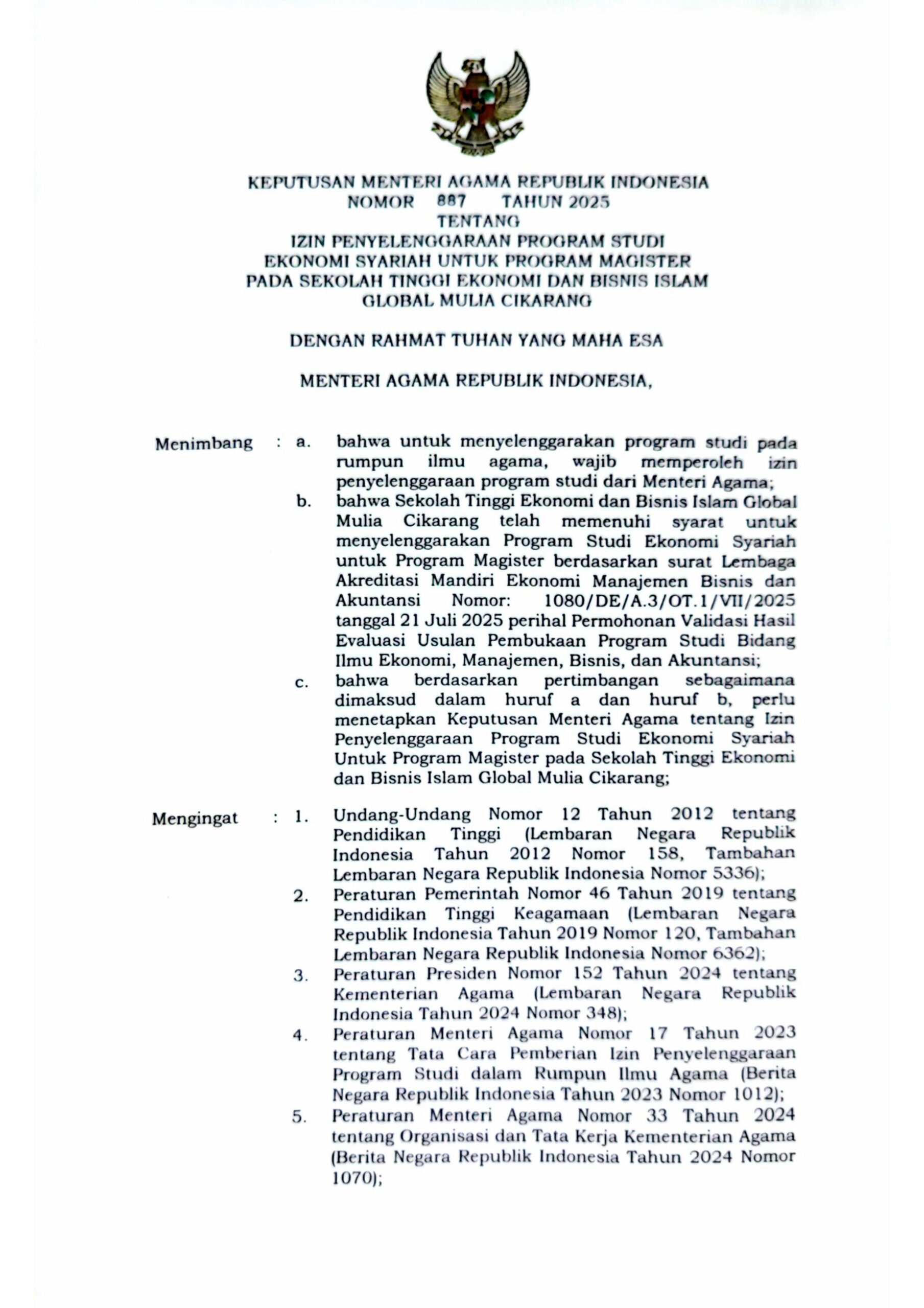
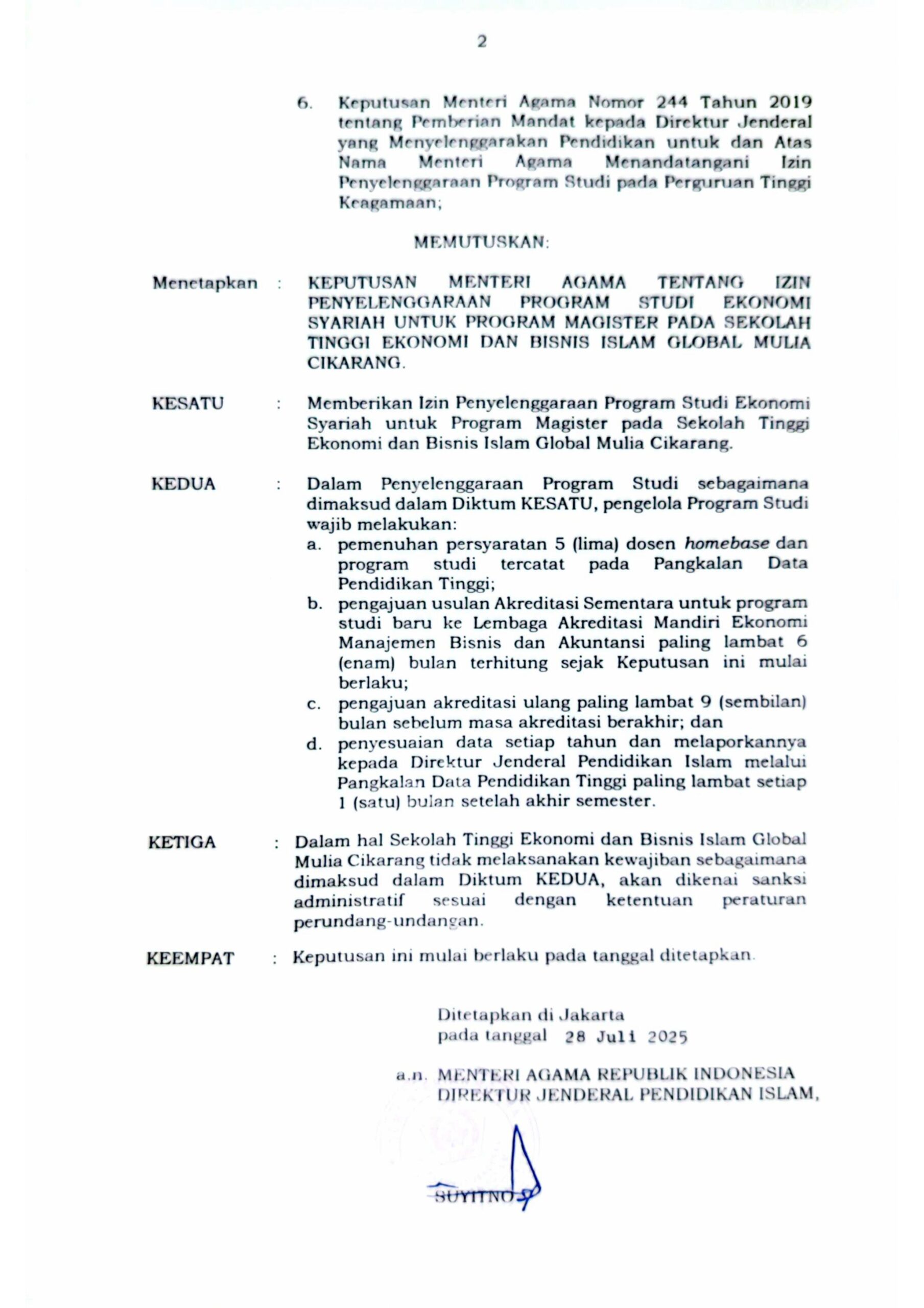
Master Degree - ISLAMIC ECONOMICS STUDY PROGRAM
Vision
To Become a Leading Master’s Study Program in Islamic Economics Based on Research and Entrepreneurship with Global Competitiveness by 2035
Mission
- To provide master’s-level education grounded in sharia-based research and entrepreneurship, producing graduates who are competent, professional, morally upright, and globally competitive.
- To develop high-quality and applicable research in the fields of Islamic economics and finance to support the advancement of knowledge and sharia-based business practices at national and international levels.
- To carry out community service based on sharia-oriented research and entrepreneurship to sustainably promote societal welfare.
- To implement the principles of good governance in the management of the study program in a transparent, accountable, and efficient manner.
- To develop academic programs based on digitalization and internationalization to support the quality of Islamic economics education.
- To improve the quality of human resources through lecturer and student exchange programs with domestic and international institutions.
- To optimize the study program’s role in the global ecosystem through the organization of academic forums such as international conferences and seminars.
- To create an academic environment that is conducive to innovation, collaborative research, and the development of globally standardized Islamic entrepreneurship.
Goals
- To produce master’s graduates with high competence in Islamic economics and finance, who are professional, morally upright, and capable of competing globally.
- To increase the quantity and quality of research and scientific publications in nationally accredited and internationally reputable journals.
- To expand strategic partnerships with the halal industry, Islamic financial institutions, government, and global educational institutions.
- To develop a sharia-based entrepreneurship ecosystem grounded in research and innovation, capable of producing successful entrepreneurs at national and international scales.
- To strengthen the study program’s governance system through information technology and quality management approaches aligned with global standards.
- To enhance the study program’s contribution to community empowerment through research-based, entrepreneurship-driven, and internationally collaborative service programs.
- To increase the study program’s competitiveness through achieving excellent accreditation and national as well as international certifications.
- To develop a curriculum and learning approach that aligns with international standards and global best practices.
Strategies
- To develop a master’s program curriculum based on sharia-oriented research and entrepreneurship that is adaptive to global developments.
- To enhance the capacity of lecturers and educational staff through training, certification, and advanced studies at national and international levels.
- To improve digital facilities and infrastructure that support globally standardized academic and research activities.
- To encourage research collaboration between lecturers, students, and national and international institutions as well as the industrial sector.
- To optimize the role of Islamic business incubators and study centers as hubs for sharia research and entrepreneurship development.
- To strengthen the study program’s information technology-based governance system that is transparent and accountable.
- To develop community service programs based on social entrepreneurship and Islamic economic empowerment with a global perspective.
- To improve access to research funding, educational grants, and business opportunities through strategic domestic and international partnerships.
- To organize lecturer and student exchange programs with overseas partner institutions to strengthen international academic networks.
- To hold international conferences, seminars, and training programs to broaden global perspectives and collaborations.
- To encourage the use of international languages in the learning process, research, and scientific publications.
- To develop internationally relevant certification programs in the fields of Islamic economics and finance to enhance graduate competitiveness.
Concentrations, Career Prospects, Lecturers & Graduate Profile
Concentrations & Career Prospects
Lecturers
Graduate Profile
Concentrations & Career Prospects
| No | Concentrations | Career Prospects |
| 1 | Human Resource Management (HRM) | HR manager, recruitment and selection specialist, trainer and developer, HR consultant, compensation and benefits manager, employee relations manager, training and development manager, compliance specialist, HR business partner, HR administration staff, etc. |
| 2 | Marketing Management (MPM) | Marketing manager, marketing analyst, brand manager, digital marketing specialist, sales manager, product manager, promotion coordinator, public relations manager, social media manager, market research manager, marketing administration staff, etc. |
| 3 | Business Management (MBS) | Entrepreneur, business manager, management consultant, entrepreneur, business analyst, project manager, business developer, operational manager, retail manager, production manager, quality manager, business administration staff, etc. |
Lecturers
| No | NIDN | Lecturer Name | Functional Position | Rank/Group |
| 1 | ||||
| 2 | 0418047601 | Dr. Yoyo Hambali, S.Ag., M.A. | Lecturer | Penata Tk.I / III-D |
| 3 | 0318046903 | Dr. Suherman, M.Ag | Lecturer | Penata / III-C |
| 4 | 9903016270 | Dr. Hardiyat, M.Pd | Lecturer | Penata / III-C |
| 5 | 2109027201 | Bachtiar Arif, S.P., M.M | Lecturer | Penata / III-C |
| 6 | 2112067603 | Finda Findiana, S.Sos., M.M | Lecturer | Penata / III-C |
| 7 | 2108018503 | Anis Nurul Khoirunnisa, S.Psi., M.M | Lecturer | Penata / III-C |
| 8 | 2110108505 | Dede Andriyana, S.Pd.I., M.M | Lecturer | Penata / III-C |
| 9 | 2116128201 | Muhammad Nazieh Ibadillah, S.H.I., M.S.I | Lecturer | Penata / III-C |
| 10 | 0425127504 | Saefulloh, S.Ag., M.M | Lecturer | Penata / III-C |
| 11 | 2107067401 | Teguh Wibowo, S.E., M.M | Expert Assistant | Penata Muda Tk.I/III-B |
| 12 | 0407057712 | Zamroni, S,T., M.M | Expert Assistant | Penata Muda Tk.I/III-B |
| 13 | 2106078104 | Dona Ramadhan, S.IP.,M.M | Expert Assistant | Penata Muda Tk.I/III-B |
| 14 | 2121029103 | Febrima Ayuningrum, S.Pd., M.Pd | Expert Assistant | Penata Muda Tk.I/III-B |
| 15 | 2126049201 | Fitri Astuti, S.E.I., M.E.K | Expert Assistant | Penata Muda Tk.I/III-B |
| 16 | 2125049003 | Muhammad Imam Fauzi, S.Sos.I., M.E. | Expert Assistant | Penata Muda Tk.I/III-B |
| 17 | 2110039305 | Nia, S.S., M.Hum | Expert Assistant | Penata Muda Tk.I/III-B |
| 18 | 2104087401 | Rohwan, S.H., M.H | Expert Assistant | Penata Muda Tk.I/III-B |
| 19 | 2119029503 | Moh. Gufron Romadhoni, S.Pd., M.M | Expert Assistant | Penata Muda Tk.I/III-B |
| 20 | 2113127301 | Vera Susanti, S.Pd.I., M.Pd | Instructor | – |
| 21 | 2125089602 | Chaerun Nisa, S.E., M.E | Instructor | – |
| 22 | 2104038003 | Royani, S.Th.I., M.A | Instructor | – |
Graduate Profile
| No | Graduate Profile | Graduate Profile Description |
| 1 | Sharia Economic Consultant | A Master’s degree capable of providing strategic analysis and recommendations on the application of Sharia economic principles across various sectors. This Master’s degree equips graduates with the analytical skills, in-depth understanding of regulations, and problem-solving skills necessary for developing sound policies. |
| 2 | Sharia Economics Researcher | A Master’s degree that explores Sharia economic issues, data analysis and critical thinking skills, and produces national and international scientific publications through access to a broad research network. |
| 3 | Academics | A Master who is able to develop curriculum and teach Islamic economics with an interdisciplinary approach, designing and solving Islamic economic problems by utilizing scientific competence, intellectual abilities, professionalism, and Islamic ethical principles. |
| 4 | Sharia Business Practitioner | A Master who is able to develop and manage ethical and sustainable businesses, which integrate theory, practice, Sharia values, and ethical or moral principles. |